
|
LiFePO4 vs. AGM Lead-Acid: A Drop-In Replacement Guide |
Executive Summary
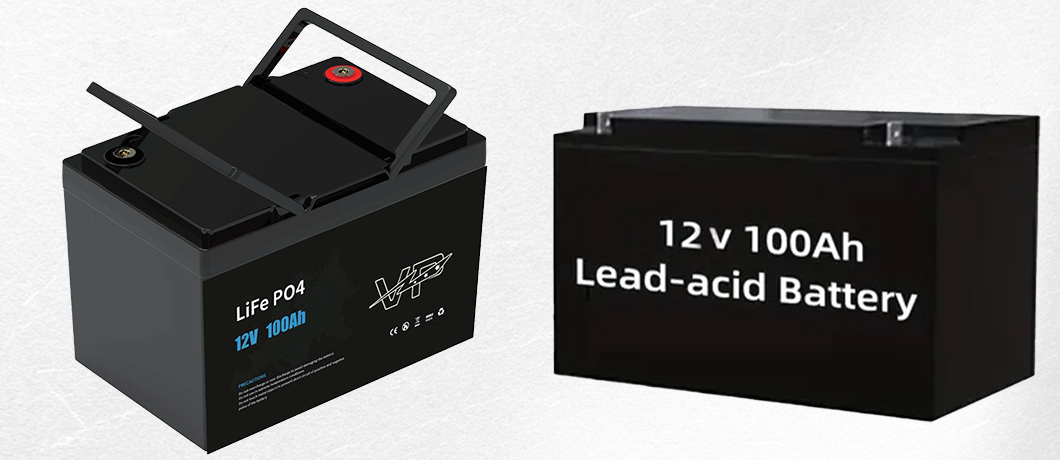
A 12.8V LiFePO4 100Ah battery is electrically and physically compatible with existing 12V AGM lead-acid installations. For distributors and system integrators evaluating battery technology upgrades, this guide provides the technical compatibility data, total cost of ownership analysis, and deployment considerations needed to make and defend a procurement decision.
1. Electrical Compatibility: What the Numbers Actually Mean
A common point of confusion in procurement is the nominal voltage difference: lead-acid is rated 12V while LiFePO4 is rated 12.8V. In practice, this distinction is commercially irrelevant for the following reasons:
|
Voltage Compatibility Summary Full-charge voltage: Both chemistries charge to 14.4V–14.6V — within the operating range of standard inverters, charge controllers, and DC loads. Float voltage: LiFePO4 targets 13.5V–13.8V vs. AGM's 13.6V–13.8V — effectively identical. Load compatibility: Equipment rated for 12V lead-acid systems (inverters, trolling motors, DC-DC converters, LED lighting) operates without modification. BMS cutoff: The integrated BMS handles low-voltage disconnection, so loads are not exposed to damaging under-voltage conditions. |
For projects that require charger reconfiguration, the recommended parameters for most commercial charge controllers are:
- Bulk / Absorption voltage: 14.4V–14.6V
- Float voltage: 13.5V–13.8V
- Equalization: Disable (LiFePO4 does not require equalization and will reject the pulse via BMS)
2. Usable Energy & Cycle Life: The Numbers That Drive ROI
The most commercially significant difference between these chemistries is not voltage — it is the usable energy ratio and cycle life, which together determine total cost of ownership over the project lifetime.
Depth of Discharge
AGM lead-acid batteries are rated at 100Ah total capacity, but we recommend limiting discharge to 50% (50Ah usable) to avoid accelerated degradation. LiFePO4 allows 100% depth of discharge without long-term impact on cycle life.
Practical implication: A single 12.8V 100Ah LiFePO4 unit delivers 1,280 Wh of usable energy — the equivalent output of two 100Ah AGM batteries connected in parallel. For projects with fixed cabinet or tray dimensions, this doubles the effective energy density without any physical expansion.
Cycle Life Comparison
At 80% depth of discharge:
- AGM lead-acid: 300–600 cycles (approximately 1–2 years in daily cycling applications)
- LiFePO4: 4,000–6,000 cycles (approximately 11–16 years under the same conditions)
For residential ESS, commercial backup, and off-grid solar applications — where batteries cycle daily — this translates directly into the number of warranty replacement calls your service team will handle.
3. Physical & Installation Compatibility
Dimensional compatibility is a prerequisite for drop-in replacement projects. Our 12.8V 100Ah series uses standard international casings, ensuring direct fitment in existing battery trays, enclosures, and rack mounts.
|
Parameter |
AGM 100Ah |
LiFePO4 100Ah |
|
Dimensions (L×W×H) |
330×171×214 mm |
330×171×214 mm (std.) |
|
Weight |
28–32 kg |
10–13 kg |
|
Terminal type |
M6 / M8 bolt |
M6 / M8 bolt (compatible) |
|
Operating temp. |
-20°C to +50°C |
-20°C to +60°C |
|
IP Rating |
Not rated |
IP54 (series dependent) |
4. Integrated BMS: Reducing Post-Sale Service Costs
Unlike AGM batteries, which rely entirely on external protection equipment, commercial-grade LiFePO4 units incorporate an onboard Battery Management System (BMS).
The following protection functions are implemented at the cell level:
|
Protection Function |
Threshold |
Benefit to Integrators |
|
Overcharge Protection (OVP) |
≤3.65V/cell |
Eliminates thermal runaway risk |
|
Over-discharge (UVLO) |
≥2.5V/cell |
Prevents irreversible cell damage |
|
Overcurrent (OCD) |
Configurable |
Protects inverter & load circuits |
|
Short-Circuit (SCP) |
<200μs response |
Reduces warranty claims |
|
Cell Balancing (passive) |
±20mV tolerance |
Extends pack service life |
|
Temp. Protection |
-20°C to +60°C |
Safe operation in field conditions |
For system integrators managing residential ESS portfolios, the absence of a BMS in AGM systems is the leading cause of early-failure warranty claims — typically from over-discharge events during extended grid outages. Switching to LiFePO4 with integrated BMS eliminates this failure mode at the hardware level.
|
Advanced Deployment Note For multi-bank or large-scale installations, our commercial series supports the following: - CAN / RS485 communication protocol for integration with most major inverter brands - Parallel expansion to 4 units (400Ah per 12V bank) without additional balancing equipment - Optional low-temperature heating pad (-40°C cold-start) for outdoor and cold-climate deployments - Scalable architecture: 12V, 24V, and 48V nominal configurations using the same cell platform |
5. Charger & Solar Charge Controller Compatibility
This is the most common technical question raised during procurement. The short answer: most existing equipment is compatible without hardware replacement.
|
Charger Type |
Compatibility |
Recommended Action |
|
AGM / GEL mode (no desulfation pulse) |
Compatible |
Use directly; verify float voltage ≤13.8V |
|
Multi-stage charger with LiFePO4 profile |
Ideal |
Select LiFePO4 mode; no changes required |
|
PWM solar controller (basic) |
Compatible |
Set bulk to 14.4V, float to 13.6V |
|
MPPT controller (programmable) |
Ideal |
Configure LiFePO4 profile; disable equalization |
|
Charger with auto desulfation pulse |
Not compatible |
Replace or disable desulfation function |
6. Application Matrix: Where This Upgrade Delivers Greatest ROI
Not all applications benefit equally. The following assessment helps prioritize which client projects should be first in line for LiFePO4 transition proposals:
|
Application |
Primary Driver |
Key Concern Addressed |
ROI Priority |
|
Residential off-grid solar ESS |
Daily cycling |
Eliminates 18-month AGM failure cycle |
High |
|
RV & marine power systems |
Weight + space |
Payload reduction, runtime per charge |
High |
|
Commercial backup power |
Reliability |
BMS protection; no under-discharge failure |
High |
|
Telecom & industrial UPS |
Long-term TCO |
Reduced maintenance intervals |
Medium |
|
Seasonal or standby applications |
Self-discharge |
<3%/mo vs. 15% prevents discharge damage |
Medium |
7. Full Technical Specification Comparison
|
Specification |
12V 100Ah AGM Lead-Acid |
12.8V 100Ah LiFePO4 |
|
Cycle Life (to 80% capacity) |
300–600 cycles |
4,000–6,000 cycles |
|
Usable Energy (100Ah) |
~600 Wh (50% DoD limit) |
~1,280 Wh (100% DoD) |
|
Replacements over 10 Years |
4–5 units |
0–1 unit |
|
Monthly Self-Discharge |
10–15% |
<3% |
|
Weight (100Ah) |
28–32 kg |
11–13 kg |
|
BMS / Protection |
None (external only) |
Integrated (OCD, OVP, SCP) |
|
Certifications Available |
Limited |
UN38.3, MSDS, CE, RoHS, UL |
|
Lifespan |
5 years |
10 years |
We support distributors, system integrators through the full procurement and deployment cycle:
- Pre-sales technical consultation: application sizing, compatibility verification, system design review
- Certification documentation: UN38.3, MSDS, CE, RoHS, and UL test reports on request
- OEM / private label: custom labeling, packaging, and firmware configuration available from MOQ 100 units
- Sample orders: evaluation units available from MOQ 10 with full spec documentation.
|
Ready to Evaluate for Your Next Project? Our engineering team provides pre-sales technical support, application-specific sizing, and full certification documentation. Request Bulk Pricing (MOQ 10+) Certifications: UN38.3 | MSDS | CE | RoHS | UL Listed |
Specifications subject to product series. Contact our engineering team for application-specific parameters.